How MSP Support Tiers Reduce Downtime and Escalation Delays – Insights from an Spokane IT Firm
Spokane Valley, United States - September 4, 2026 / Nuvodia – Spokane Managed IT Services Company /
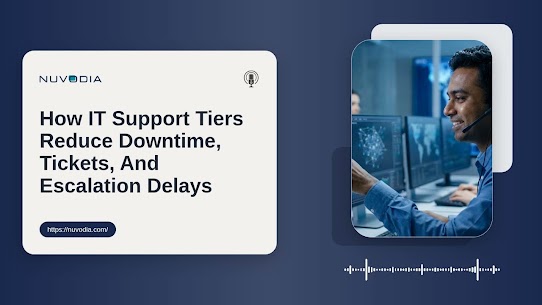
Spokane IT Company Explains How Support Tiers Reduce Downtime
Tickets wait in the wrong queue, staff lose time on repeat issues, approvals slow down, and urgent outages fail to reach the right technician. That is why IT support tiers matter as an operating model, not just a help desk chart.
Ticket volume adds pressure, with 75% of customer service reps saying they saw the highest ever volume in customer service tickets. Our IT company in Spokane uses proactive IT strategy and customer care to help you keep operations moving while IT needs are managed with care.
Bryan De Donato, , Chief Operations Officer at Nuvodia, notes: "Clear tiering prevents avoidable handoffs by matching each request to the right skill level, business priority, and escalation path before downtime spreads."
IT Support Tiers Explained For Daily Operations
In this post, a premier Spokane IT company determine who handles each issue, how fast it moves, and when escalation happens.
Without that structure, a Microsoft access request, printer failure, and recurring application crash compete for the same attention, even though each requires different skills and urgency. In practical terms, IT support tiers explained through daily workflows help reduce repeat tickets, clarify ownership, and protect staff time.
Tier 0 self-service: Approved knowledge base articles, password guidance, and basic how-to steps help users solve routine issues safely. Password resets need structure because Gartner reports that 40% of help desk calls are tied to password expirations, changes, and resets.
Tier 1 help desk: Our responsive help desk handles intake, triage, common fixes, user updates, and ticket ownership.
Tier 2 technical support: Technicians investigate applications, devices, permissions, and recurring incidents that need deeper review.
Tier 3 specialists: Senior resources handle network, cloud, cybersecurity, vendor coordination, and root cause work.
A clinic workstation login issue may start as a password ticket, then reveal a Microsoft profile or device health problem. Routing determines whether the user gets a quick reset or waits while the wrong team investigates.
The value shows up in help desk triage, network support, Microsoft administration, and security escalation.
What Is The Difference Between Different IT Support Tiers In Ticket Handling
A user reports that an application is unavailable, but the cause may be credentials, workstation health, cloud access, network performance, or a security alert. The practical answer to what is the difference between different IT support tiers is ownership, expertise, access level, risk, and business impact.
Intake and user communication
Tier 1 gathers details, checks known fixes, and sets expectations. The user should not repeat the same story while a deadline waits.Deeper technical investigation
Tier 2 reviews logs, permissions, device status, application behavior, and recurring patterns. This is where a file access ticket becomes a permissions or sync issue instead of a one-time workaround.Specialist escalation and design
Tier 3 handles network architecture, cloud configuration, security controls, vendor escalation, and root cause analysis. Our Fortinet and Microsoft expertise matters when the ticket touches firewall behavior, identity settings, or cloud policy.Security-sensitive escalation
Suspicious login activity, malware warnings, unusual Fortinet firewall events, or Microsoft account compromise need fast movement. Treating those tickets like normal user requests increases risk.Business priority alignment
A payroll system issue, clinical workflow interruption, production device outage, or client-facing portal failure should not wait behind low-impact requests.
Tiering works when IT and leadership agree on priority rules before tickets arrive.
IT Technical Support Tiers And Their Business Impact
Support tiers affect invoices, approvals, productivity, downtime, and customer service because they control how work moves through support.
Fewer stalled support tickets
Clear ownership reduces “waiting on IT” when an invoice approval system, shared folder, or shipping workstation stops working. Well-designed IT technical support tiers also prevent unresolved handoffs.Better use of skilled labor
Senior engineers should focus on infrastructure, security, cloud, and recovery work, not routine password or printer issues. Organizations have reported a 24% reduction in help desk tickets when reduced troubleshooting and maintenance effort improved IT efficiency.Faster response to priority issues
Priority rules should reflect business impact. A dispatch system outage needs a different path than a cosmetic monitor setting because one stops customer service while the other can wait.Cleaner security escalation
Suspicious activity, access problems, and endpoint alerts need defined handling so security risk does not move through the same queue as routine requests.More useful technical reviews
Ticket trends should feed technical business reviews so leadership sees recurring problems, budget needs, and improvement opportunities. Respondents with Windows 365 experience reported an average help ticket volume reduction of 13.4%.
For priority 1 issues, we set a 60-minute SLA, supported by proactive monitoring and security management without overpromising resolution time.
IT Support Tiers For Security Recovery And Continuity
The same support structure used for everyday tickets becomes more important during a security incident, system outage, failed backup, or disrupted site access.
Tiering must connect to security operations, backup validation, disaster recovery planning, and leadership communication. Security delays are measurable, with a survey finding that 56 minutes pass on average before anyone acts on an alert, while Unit 42 reported 13% of social engineering incidents traced to ignored or untriaged alerts. During wider outages, a study found that 759 U.S. hospitals experienced IT outages due to a faulty CrowdStrike update, and of 1,098 distinct network services with outages, 21.8% were direct patient-facing services and 15.4% were operationally relevant services.
Security alert routing: Suspicious sign-ins, firewall alerts, malware warnings, and unusual account behavior need a defined path to the right security resource.
Backup recovery checks: Backup failures need timely review so recovery gaps are found before a disruption exposes them.
Vendor coordination rules: Software, internet, cloud, and device vendors need clear ownership for follow-up and evidence gathering.
Leadership update cadence: Updates must be clear enough to support decisions during downtime or active investigation.
We bring IT disaster recovery experience across the Pacific Northwest and Desert Southwest, including Tucson, AZ, with 24/7 support, real-time threat analysis, 24/7 security operations, smart vulnerability management, and customized strategies. In Trend Micro's Risk to Resilience World Tour Survey, 33% of respondents said they rely on managed detection and response or managed security service provider offerings, reinforcing the value of clear escalation paths.
Changing IT support tiers takes coordination across people, tools, and expectations.
Map common ticket types to the correct tier.
Define priority 1 criteria using business impact.
Review security and recovery escalation paths before an incident occurs.
Build Smarter IT Support Tiers
Reduce misrouted tickets and escalation delays with an IT support model designed around your operations. Nuvodia can help you plan the right structure.
Talk to Nuvodia
Clear tiers of IT support help the right person handle the right issue at the right time, which reduces disruption, improves planning, and gives leadership better visibility into recurring problems.
We turn that model into an operating plan through responsive help desk support, Virtual CIO services, technical business reviews, managed IT services, managed security services, cloud solutions, network support, consulting, and backup and disaster recovery.
Plan Professional IT Support Tiers With a Spokane IT Company
Contact Nuvodia, an expert IT firm in Spokane, for a complimentary technology review if you want fewer unresolved tickets, stronger escalation, and more time to run the business while we keep bringing your vision to life through the power of technology.
Source
This release is based on the article How IT Support Tiers Reduce Downtime, Tickets, And Escalation Delays.


Contact Information:
Nuvodia – Spokane Managed IT Services Company
2818 N Sullivan Rd #100A
Spokane Valley, WA 99216
United States
Sean Harrell
(509) 755-9400
https://nuvodia.com/


