Creating a new generation of master crafters from the nation's workforce
PR Newswire
BEIJING, Nov. 22, 2026
BEIJING, Nov. 22, 2026 /PRNewswire/ -- A report from China Daily.
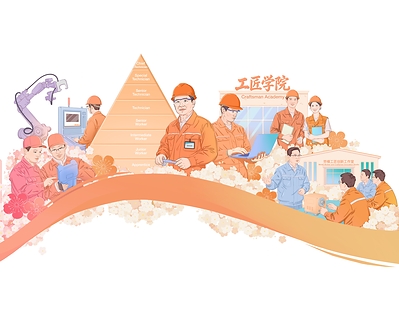
The All-China Federation of Trade Unions recently released the 2026 list of 200 craftsman academies selected for key support as part of the effort to deepen the reform of the workforce development system and enhance the technical and professional skills of workers.
The academies primarily serve key traditional industries, emerging industries and industries of the future, with a focus on tangible training outcomes and measurable improvements in workers' skills.
Of the 200 academies, 71 percent are affiliated with enterprises, 24.5 percent with vocational schools — including technical institutes — and 4.5 percent were established by trade unions. Together, they have developed 492 distinctive skilled trades covering 19 sectors of the national economy. These skilled trades are concentrated in industries such as information transmission, software and information technology services, and the production and supply of electricity, heat, gas and water, with manufacturing accounting for 55 percent of the total.
The academies offer more than 68,000 in-person courses and have published over 10,000 online skills courses. Since the beginning of this year, they have provided training to more than 1.5 million workers. Among their full-time and part-time instructors, nearly 38,600 are model workers, master craftsmen and other exemplary figures.
Li Shun, a student majoring in intelligent and connected vehicles at Shandong Transportation Craftsman Academy, is one of the beneficiaries of the academy system. "In the intelligent and connected vehicle training laboratory, I learned installation and commissioning technology from a team of master instructors," Li said. "I went from being unable to read circuit diagrams to independently troubleshooting LiDAR faults. I also took part in a field-engineer project at Weichai Power, where hands-on work on the shop floor taught me the true meaning of craftsmanship — paying close attention to every detail."
Li's growth offers an illustration of how Shandong Transport Vocational College cultivates workers for future industries through the spirit of model workers, the spirit of labor and the spirit of craftsmanship. As the first craftsman academy established in China's transportation sector and one of the first such pilot academies set up by a college in Shandong province, Shandong Transportation Craftsman Academy was jointly founded in 2020 by the Shandong provincial transport trade union committee and Shandong Transport Vocational College.
Leveraging the academic strengths of the vocational college and the resource-integration capacity of the trade union, the academy adheres to the principle of "trade union leadership, college-based development and enterprise-centered application". It has built a platform for "nurturing, passing on and promoting craftsmanship", enabling industrial workers to acquire both technical skills and the spirit that sustains them.
By adopting a "master-apprentice" mechanism, the academy has also developed an integrated training platform centered on four functions: skills improvement, innovation incubation, competition and demonstration, and talent cultivation, enabling trainees to hone their capabilities while learning from role models. Over the past few years, the academy has produced a number of technical experts, including Gao Lianjiang, a distinguished craftsman in Shandong's transportation sector, and Shi Jinshui, a recipient of the Shandong May 1 Labor Medal. More than 360 students have also passed the assessment for the title of "Qilu craftsmen".
"In the past, enterprises seeking to cultivate skilled workers often struggled with a lack of qualified instructors and adequate training facilities," said Shen Aibing, head of the training center at Seacon Shipping Group Holdings Limited. "Now, through cooperation with the craftsman academy, we can take part directly in curriculum design, translate job requirements into course content and send our employees here for further training."
According to Shen, the jointly developed training program has cultivated hundreds of technical workers for the company. "The principle of 'enterprise-centered application' brings the power of role models into the workplace, while the spirit of labor has become a driving force behind employees' growth," he added.
In 2024, the Central Committee of the Communist Party of China and the State Council issued opinions for deeper reform in building the industrial workforce, emphasizing that industrial workers are the principal force of the working class, a key force in creating social wealth and crucial to implementing the innovation-driven development strategy and accelerating the development of China into a high-quality manufacturing power.
During the 14th Five-Year Plan (2021-25), the country provided subsidized vocational skills training to over 92 million workers. The number of skilled workers nationwide exceeded 220 million, including over 72 million highly skilled workers. Trade unions cultivated and recognized more than 73,000 craftsmen and craftswomen at various levels and in different fields.
Career development pathways have become clearer. China has explored the establishment of a new eight-level vocational skill grading system. During the 14th Five-Year Plan, more than 44 million workers obtained vocational skills grade certificates, while more than 6,000 technicians were appraised and hired as special technicians or chief technicians.
Workers' incomes have also increased. Efforts have been made to encourage enterprises to conduct collective wage consultations based on skill levels. In 2025, 87,000 collective contracts providing compensation incentives for skilled workers were signed, covering 8.51 million people.
 View original content to download multimedia:https://www.prnewswire.com/news-releases/creating-a-new-generation-of-master-crafters-from-the-nations-workforce-302947839.html
SOURCE China Daily

