Bale Collision Center is helping drivers in the Chenal area of Little Rock better understand what happens during ADAS calibration and why it has become an important step in repairing many modern vehicles. As advanced driver-assistance systems become increasingly common, professional collision repairs often include inspections and calibration procedures designed to support these sophisticated technologies after qualifying repairs.
According to Bale Collision Center, many vehicle owners are unfamiliar with ADAS until their vehicle requires collision repairs. Advanced Driver Assistance Systems, commonly known as ADAS, include features such as forward collision warning, automatic emergency braking, lane departure warning, lane keeping assistance, adaptive cruise control, blind spot monitoring, parking sensors, and surround-view camera systems. These technologies rely on precisely positioned sensors and cameras to operate as designed.
Serving Chenal and surrounding Little Rock communities, Bale Collision Center provides collision repair services for vehicles equipped with advanced safety technologies. The company explains that understanding the calibration process helps customers better appreciate why certain repairs involve more than replacing damaged body panels.
"Today's vehicles are equipped with technology that simply didn't exist a decade ago," said a representative of Bale Collision Center. "When repairs involve components connected to these systems, calibration may be required according to manufacturer procedures to help ensure those technologies function as intended."
The company explains that the calibration process begins long before specialized equipment is connected to the vehicle. Every repair starts with a detailed inspection to determine which safety systems are installed and whether manufacturer repair procedures call for calibration based on the type of collision damage or repairs being performed.
Many ADAS components are located behind the windshield, front grille, bumpers, side mirrors, or rear body panels. Because these components are mounted with precise alignment, even relatively minor impacts can affect their positioning. Repairs involving bumper replacement, windshield replacement, suspension work, steering components, wheel alignment, or structural repairs may require calibration depending on the manufacturer's recommendations.
Once technicians determine calibration is appropriate, they review the vehicle manufacturer's repair documentation to identify the required procedures. Bale Collision Center explains that calibration methods vary significantly between vehicle manufacturers and even among different models produced by the same manufacturer. Following manufacturer-informed repair procedures helps ensure the correct calibration method is selected for each individual vehicle.
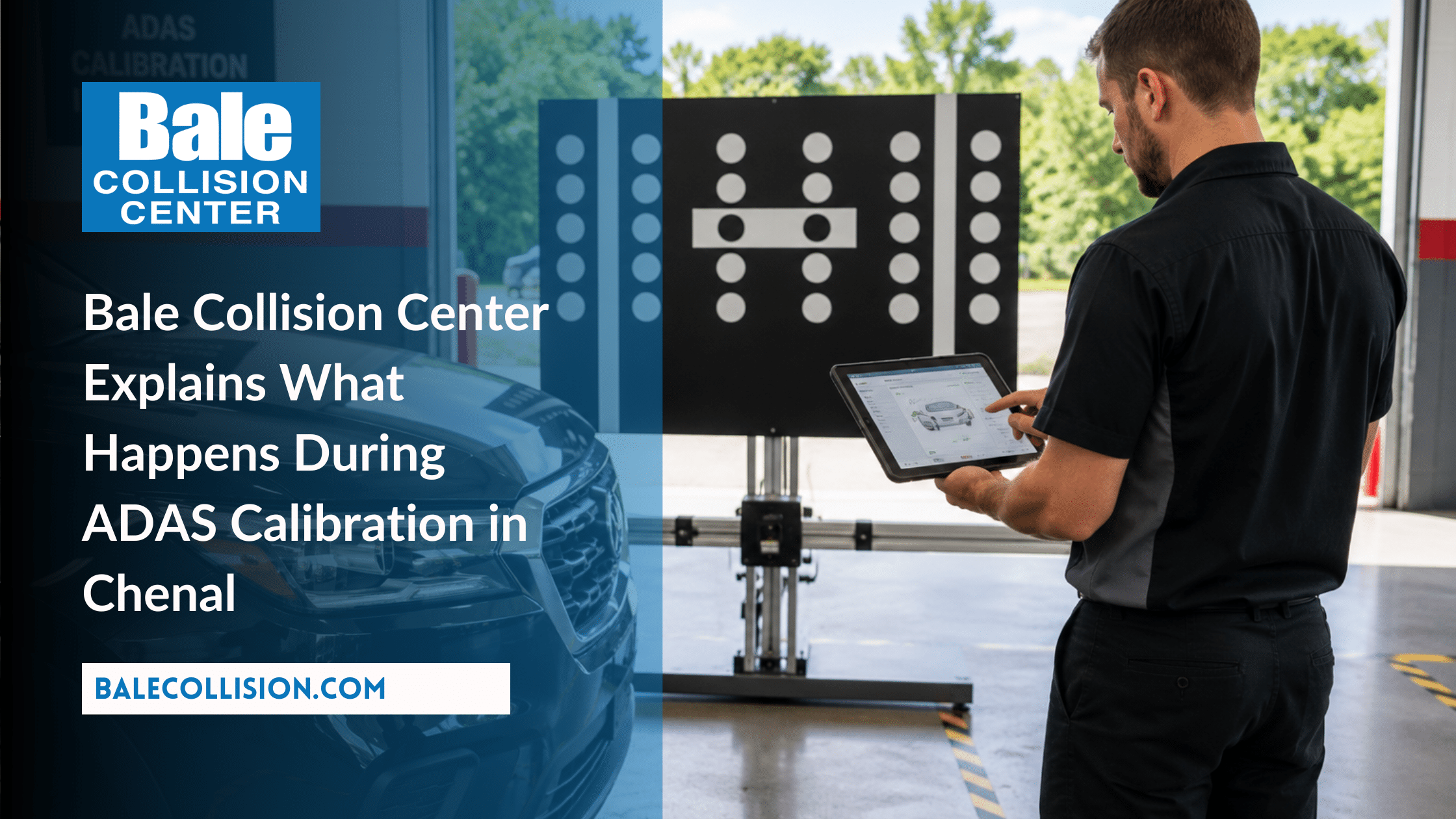
The company notes that ADAS calibration generally falls into two categories: static calibration and dynamic calibration. Static calibration is performed inside the repair facility using specialized equipment, measurement tools, and calibration targets positioned at manufacturer-specified distances from the vehicle. Dynamic calibration, by contrast, requires driving the vehicle under controlled conditions while onboard systems complete the calibration process. Some vehicles require only one method, while others require both procedures before repairs are complete.
Customer education is an important part of the repair experience. Many Chenal drivers wonder why calibration is necessary if cameras or sensors were not visibly damaged during the collision. Bale Collision Center explains that these systems depend on extremely precise positioning. Even slight changes caused by impact, component replacement, or repair work may influence how sensors interpret the surrounding environment. Calibration helps verify those systems operate according to manufacturer specifications after qualifying repairs.
The company also emphasizes that ADAS calibration is not limited to major accidents. In some cases, replacing a windshield, repairing a bumper, performing suspension work, or completing a wheel alignment may also require calibration procedures depending on the vehicle manufacturer's recommendations. Each vehicle is evaluated individually because calibration requirements vary by make, model, and repair type.
Specialized equipment plays an important role throughout the process. Modern calibration systems use advanced measuring technology to position calibration targets accurately while communicating with the vehicle's onboard electronic systems. Bale Collision Center continues investing in diagnostic equipment and technician training to support the repair requirements of today's increasingly technology-driven vehicles.
Quality control remains an essential part of every repair. Before a repaired vehicle is returned to its owner, technicians review completed repairs, verify manufacturer-recommended procedures have been followed, and perform final quality inspections. When ADAS calibration is required, those procedures become an important part of the overall repair plan to help support proper operation of the vehicle's advanced safety systems.
As automotive manufacturers continue introducing new driver-assistance technologies, collision repair continues evolving alongside them. Cameras, radar sensors, ultrasonic sensors, and other electronic systems are becoming standard equipment on many new vehicles, making calibration an increasingly common part of professional collision repair.
By helping customers understand what happens during ADAS calibration, Bale Collision Center aims to remove uncertainty from the repair process while reinforcing the importance of following manufacturer-informed repair procedures. The company remains committed to combining experienced technicians, advanced repair technology, and transparent communication to serve drivers throughout Chenal and the greater Little Rock area.
Learn more about ADAS calibration in Chenal, Little Rock, AR by visiting Bale Collision Center's ADAS calibration page. Additional company updates, repair information, and community news are available on Bale Collision Center's Facebook page.
About Bale Collision Center
Bale Collision Center proudly serves drivers throughout Chenal, Downtown Little Rock, and surrounding Central Arkansas communities with professional collision repair and auto body services. The company provides ADAS calibration, collision repair, auto body repair, paintless dent repair, auto glass replacement, auto paint refinishing, and comprehensive vehicle restoration using experienced technicians, advanced repair equipment, and manufacturer-informed repair procedures. Bale Collision Center is committed to delivering quality workmanship, transparent communication, and dependable customer service throughout every stage of the repair process.
###
For more information about Bale Collision Center, contact the company here:
Bale Collision Center (Chenal)
Jason Spiller
(501) 221-7181
jspiller@baleautomotive.com
13101 Chenal Pkwy, Little Rock, AR 72211, United States
