
All County Collision is publishing consumer guidance explaining how Advanced Driver Assistance Systems (ADAS) repair records can influence buyer confidence when purchasing a previously damaged vehicle. The November publication focuses on why documentation of diagnostic evaluations, manufacturer-required calibrations, and completed collision repairs can help Florida drivers provide greater transparency about a vehicle's condition and accident history.
As modern vehicles become increasingly dependent on cameras, radar sensors, and electronic safety features, buyers may have additional questions about how these systems were evaluated following an accident. A vehicle may appear fully repaired on the outside, but its electronic systems can require procedures that are not immediately visible during a routine inspection.
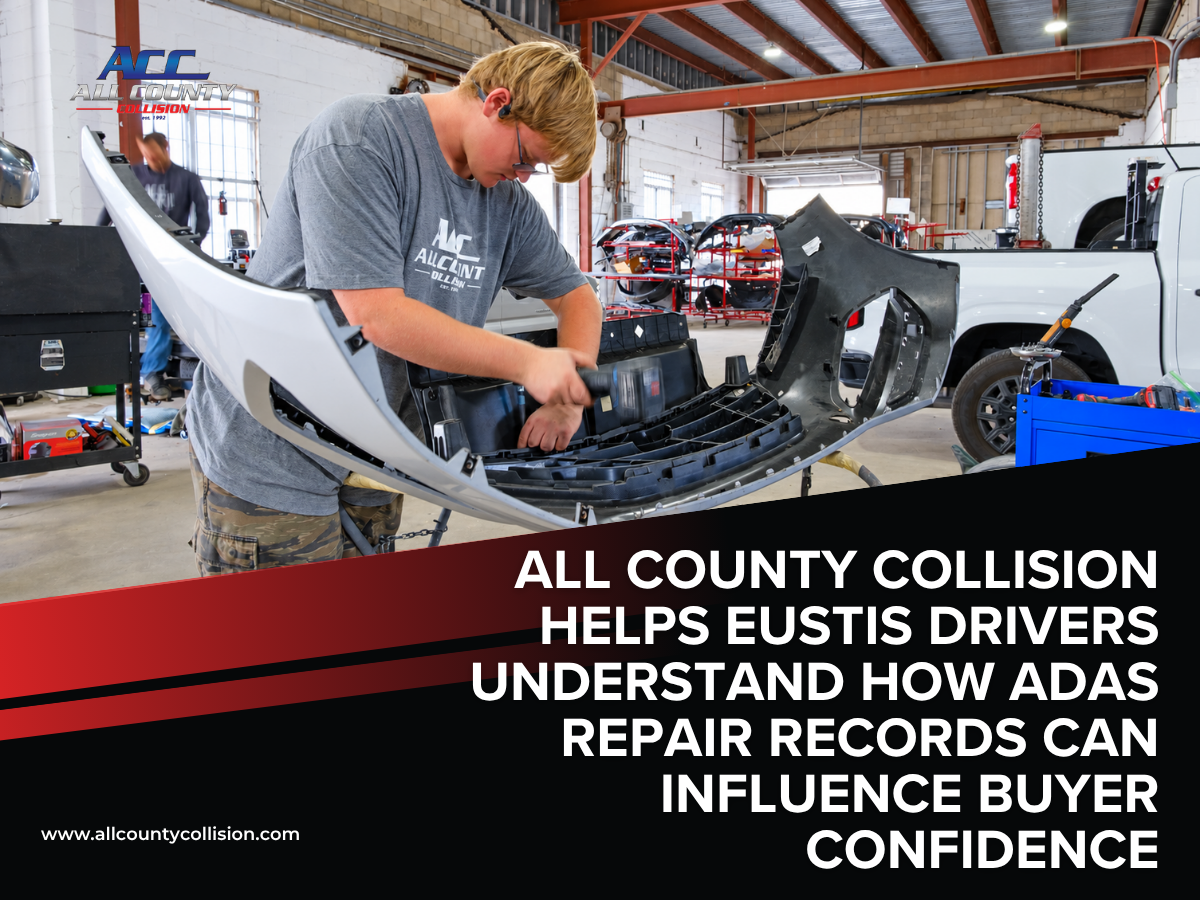
All County Collision provides ADAS calibration services for drivers in Eustis and surrounding Central Florida communities. The new guidance explains why keeping records of applicable ADAS procedures can be useful when a vehicle is eventually sold, traded in, or evaluated by a prospective buyer.
ADAS technologies support functions such as automatic emergency braking, lane departure warnings, lane-keeping assistance, adaptive cruise control, and blind-spot monitoring. These systems use information from cameras, radar units, and other components to assist drivers under specific operating conditions.
Following certain collisions or repair operations, vehicle manufacturers may require diagnostic evaluations or calibration procedures to verify that affected systems meet specified requirements.
The November publication explains that ADAS calibration is not the same as a diagnostic scan. A scan can identify certain electronic system conditions and stored diagnostic trouble codes, while calibration involves following manufacturer-defined procedures to establish or verify the operating parameters of specific cameras and sensors.
Depending on the vehicle, calibration may require stationary targets and specialized equipment, driving under specified conditions, or a combination of both approaches.
The appropriate procedure depends on the vehicle's make, model, installed equipment, and the repairs performed. Not every collision requires the same calibration operations, and the absence of dashboard warning lights does not necessarily establish that no additional procedures are needed.
For prospective buyers, these distinctions can be important because an ordinary visual inspection may not reveal whether manufacturer-required electronic system procedures were completed after an accident.
The guidance identifies several types of records that can provide useful information about a vehicle's ADAS repair history.
Diagnostic scan reports may document electronic system conditions identified during the repair process. Calibration records may identify the systems evaluated, the procedures performed, and the results recorded by the equipment or technician.
Repair estimates and final invoices can also provide context about the collision damage and the operations included in the completed repair.
Through its collision repair services, All County Collision addresses accident-related damage as part of a documented repair process. The November guidance explains how maintaining these records can help vehicle owners answer questions about previously damaged areas and related safety system procedures.
For example, a prospective buyer reviewing a vehicle's accident history may learn that it was involved in a front-end collision. Depending on the vehicle and the repairs performed, the buyer may want to know whether forward-facing cameras or radar components required evaluation or calibration.
A repair file containing relevant manufacturer procedures, diagnostic information, and completed calibration documentation can provide additional context about the work performed.
However, All County Collision emphasizes that records should not be interpreted as a guarantee of a vehicle's future performance. Documentation reflects procedures completed at a particular time and does not replace an assessment of the vehicle's current condition.
The November publication also addresses how ADAS repair documentation relates to diminished value.
Diminished value generally refers to a potential reduction in a vehicle's market value associated with its accident history or condition. Even after appropriate repairs have been completed, a previously damaged vehicle may be valued differently from a comparable vehicle without reported collision damage.
ADAS repair records cannot erase an accident history or guarantee that a vehicle will retain its pre-accident market value. However, they may help reduce uncertainty about whether relevant electronic system procedures were addressed during the repair.
The guidance distinguishes buyer confidence from a formal vehicle valuation. A buyer may feel more comfortable reviewing detailed repair records, but that does not necessarily translate into a specific increase in the vehicle's resale or trade-in price.
Market value remains dependent on factors such as vehicle age, mileage, overall condition, accident severity, repair history, and local demand.
The publication also explains that vehicle history reports may not contain detailed information about diagnostic scans or calibration procedures. These reports can provide useful accident and ownership information, but their contents depend on what has been reported to the service.
For this reason, All County Collision encourages drivers to maintain their own repair documentation instead of relying exclusively on third-party vehicle history reports.
Vehicle owners can organize their original repair estimates, supplemental estimates, final invoices, diagnostic reports, calibration records, and relevant inspection documents in one accessible file.
This information may be useful during a private sale, dealership trade-in evaluation, or future vehicle service appointment.
The guidance also encourages buyers considering a previously damaged vehicle to ask specific questions about its repair history rather than assuming that a clean dashboard or normal test drive confirms that all required procedures were performed.
Buyers may request available repair documentation, ask whether relevant ADAS components were evaluated, and consider an independent pre-purchase inspection when additional verification is appropriate.
All County Collision also provides auto body repair services for vehicles affected by collision damage. The publication emphasizes that exterior repairs and electronic system evaluations may involve different procedures, both of which can contribute to the overall repair record.
For Eustis drivers, the central takeaway is that ADAS documentation can provide meaningful information when discussing a vehicle's condition after an accident. Clear records help distinguish completed technical procedures from assumptions based solely on appearance.
The November guidance is intended to help Central Florida vehicle owners understand why preserving ADAS repair records can support informed buyer discussions, more transparent vehicle transactions, and better long-term documentation of collision repairs.
All County Collision provides collision repair, auto body repair, and ADAS calibration services at 25 S Bay St, Eustis, FL 32726, serving vehicle owners throughout Eustis and surrounding Central Florida communities.
###
For more information about All County Collision, contact the company here:
All County Collision
Ryan DeMarco
3523574599
ryan@allcountycollision.com
25 S Bay Street, Eustis, FL 32726
